
Blog
Understanding the Different Types of Research Peptides
Jun
A Comprehensive Guide to the Most Common Categories of Research Peptides
Research peptides have become an increasingly important part of modern scientific investigation, helping researchers explore biological mechanisms, molecular signaling pathways, and protein interactions with remarkable precision. As interest in peptide science continues to grow, many newcomers are surprised to discover that peptides are not all the same. They come in a wide variety of structures, each with unique characteristics that make them valuable for different areas of laboratory research.
Understanding the different types of research peptides is an essential first step for anyone interested in peptide science. This guide provides an overview of the major peptide categories commonly encountered in research settings and explains why these compounds continue to attract scientific attention around the world.
What Are Research Peptides?
Research peptides are short chains of amino acids synthesized for laboratory and scientific investigation. Unlike larger proteins, peptides contain relatively few amino acids, allowing researchers to study highly specific molecular interactions within biological systems.
Scientists utilize these compounds to investigate cellular communication, receptor binding, hormone signaling, tissue biology, metabolic pathways, and numerous other biological processes. Their versatility makes them valuable tools across biotechnology, pharmacology, molecular biology, and biochemistry.
As peptide science evolves, researchers continue discovering new applications that may contribute to a better understanding of human biology.
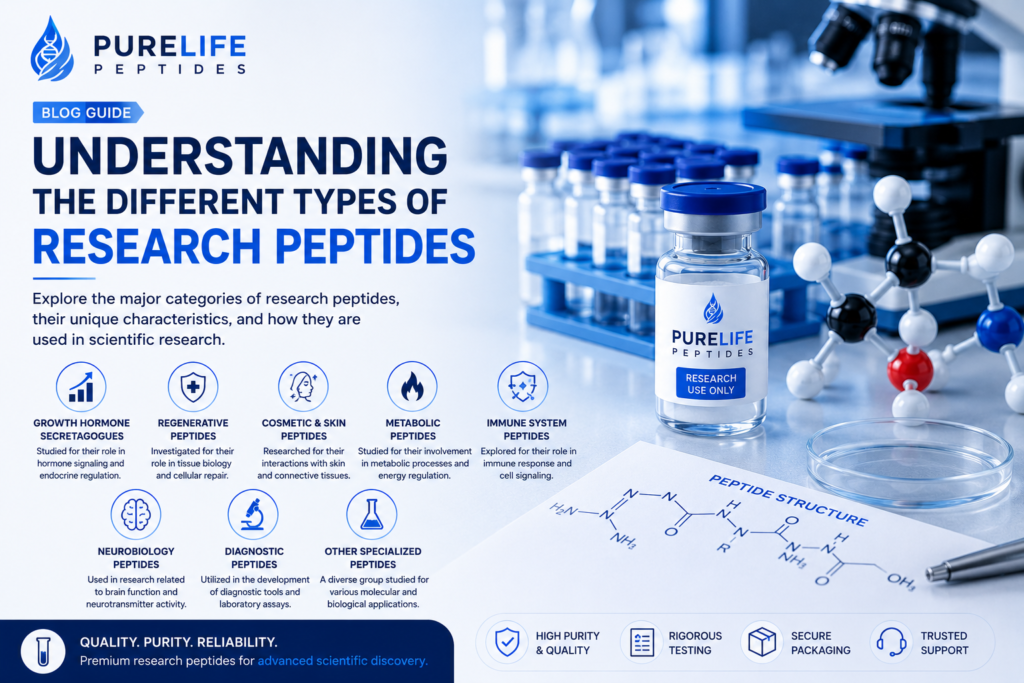
Growth Hormone Secretagogue Peptides
One of the most widely recognized categories in peptide research includes compounds known as growth hormone secretagogues. These peptides are studied because of their interactions with biological pathways involved in hormone signaling and endocrine regulation.
Examples frequently encountered in research literature include:
- CJC-1295
- Ipamorelin
- GHRP-2
- GHRP-6
Researchers investigate these compounds to better understand hormone release mechanisms and physiological regulation within controlled laboratory environments.
It is important to remember that these materials are intended strictly for scientific investigation and should only be used in accordance with applicable research guidelines.

Regenerative Research Peptides
Another category receiving significant scientific interest consists of peptides investigated for their role in tissue biology and cellular repair mechanisms.
Examples include:
- BPC-157
- TB-500
Researchers continue studying these compounds to better understand biological signaling involved in cellular communication, tissue organization, and regenerative processes.
While scientific interest remains high, research in this area continues to evolve, and further investigation is ongoing.
Cosmetic and Skin Research Peptides
Some peptides are widely studied within cosmetic and dermatological research because of their interactions with skin-related biological processes.
One well-known example is:
- GHK-Cu (Copper Peptide)
Scientific studies continue exploring the molecular pathways associated with skin biology and extracellular matrix interactions. Because peptides can influence cellular communication, they have become valuable tools in cosmetic research laboratories investigating skin physiology.
Metabolic Research Peptides
Researchers are also interested in peptides involved in metabolism and energy regulation.
Examples commonly investigated include:
- MOTS-c
- AOD-9604
These compounds are studied to better understand cellular energy utilization, metabolic signaling pathways, and mitochondrial biology. Research in this area continues to expand as scientists seek greater insight into complex metabolic systems.
Immune System Research Peptides
Certain peptides are investigated because of their interactions with immune system signaling pathways.
Researchers study these compounds to understand cellular communication between immune cells and to explore molecular mechanisms involved in immune regulation.
The field of immunology continues to benefit from peptide research as scientists investigate new biological pathways and signaling molecules.
Neurobiology Research Peptides
Peptides also play an important role in neuroscience research.
Many naturally occurring peptides function as signaling molecules within the nervous system, making them valuable tools for studying neurological communication and receptor activity.
Researchers continue investigating peptide interactions within the brain to improve scientific understanding of complex neural pathways and cognitive function.
Diagnostic Research Peptides
In addition to laboratory investigation, peptides are frequently utilized during the development of diagnostic technologies.
Scientists use synthetic peptides to create highly specific biological markers that assist in laboratory testing and biomedical research. Their precision makes them valuable tools in assay development and molecular detection techniques.
This growing area demonstrates the versatility of peptides beyond traditional biological research.
Why Peptide Quality Matters
Regardless of the peptide category being studied, quality remains one of the most important considerations.
High-quality research peptides undergo rigorous manufacturing procedures and analytical testing designed to verify identity, composition, and purity.
Reliable products contribute to reproducible laboratory experiments and help researchers maintain confidence in their findings.
When selecting a supplier, many researchers prioritize:
- High manufacturing standards
- Transparent quality control procedures
- Batch consistency
- Professional packaging
- Secure shipping
- Reliable customer service
Maintaining quality throughout production and fulfillment supports scientific integrity and dependable research outcomes.

PureLife Peptides’ Commitment to Excellence
At PureLife Peptides, we understand the importance of quality, precision, and consistency in scientific research. Our commitment is to provide premium research peptides sourced and handled according to strict quality standards while delivering a professional customer experience.
From secure packaging to dependable order processing and responsive customer support, every aspect of our operation is designed with quality in mind.
We believe that scientific advancement begins with reliable materials, and we remain dedicated to supporting researchers through excellence in every order.
Final Thoughts
Research peptides represent one of the most fascinating areas of modern biotechnology. From hormone signaling and cellular communication to metabolism, skin biology, immunology, and neuroscience, these remarkable molecules continue to expand our understanding of biological systems.
As scientific knowledge grows, so too does the importance of sourcing high-quality research materials from trusted suppliers.
Whether you are just beginning to explore peptide science or simply seeking to better understand the different categories available, developing a solid foundation in peptide biology is an important step toward appreciating their role in modern research.
