Blog
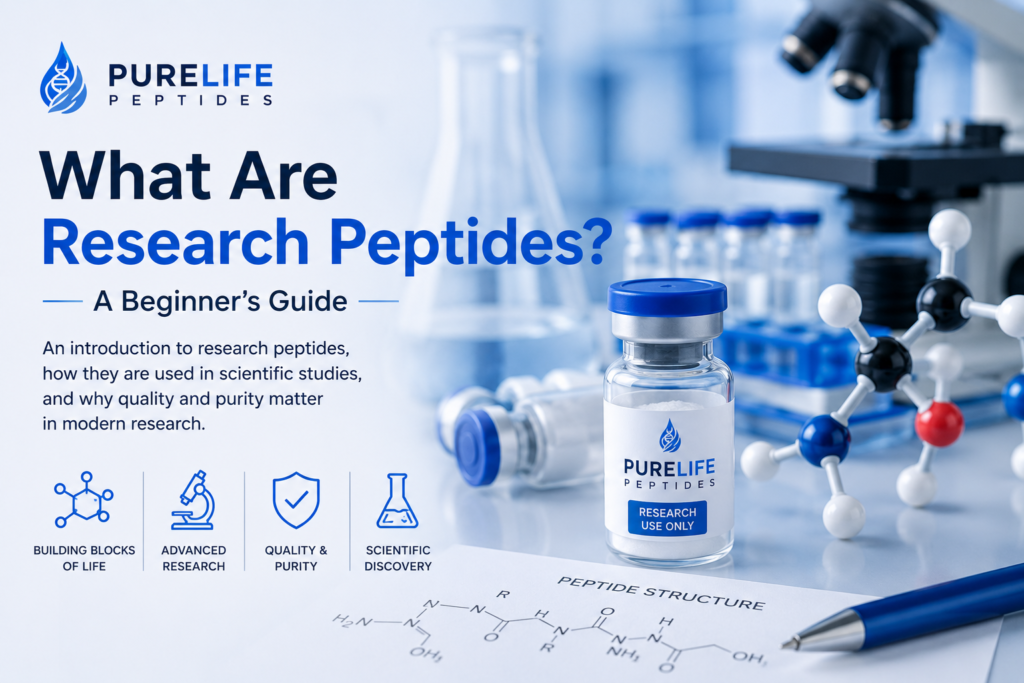
What Are Research Peptides? A Beginner’s Guide
Jun
Understanding the Building Blocks of Modern Scientific Research
The field of peptide research has grown significantly over the past decade, attracting interest from scientists, academic institutions, and biotechnology companies around the world. As new discoveries continue to emerge, research peptides have become an essential tool for studying biological processes and advancing scientific knowledge.
If you’re new to the world of peptides, you may be wondering exactly what they are, why they’re important, and how they’re used in research settings. This beginner’s guide provides an introduction to research peptides and explains their role in modern laboratory science.
What Are Peptides?
Peptides are short chains of amino acids linked together by peptide bonds. Amino acids are often referred to as the building blocks of proteins, and when a small number of these amino acids join together, they form a peptide.
Unlike larger proteins, peptides generally consist of fewer amino acids, allowing them to interact with biological systems in highly specific ways. Naturally occurring peptides can be found throughout the human body, plants, animals, and microorganisms, where they participate in numerous biological functions.
Scientists are interested in peptides because of their structural diversity and their ability to serve as valuable tools for studying complex biological mechanisms.
What Are Research Peptides?
Research peptides are peptides manufactured specifically for scientific and laboratory investigation. They are commonly used by researchers to study cellular communication, molecular interactions, receptor activity, protein function, and other biological processes.
These materials are designed to support laboratory experiments and scientific exploration. They play an important role in expanding our understanding of biology and biochemistry and are frequently used in academic and industrial research environments.

Why Are Researchers Interested in Peptides?
Peptides possess unique properties that make them useful for scientific investigation. Because of their relatively small size and precise structure, they can be studied in controlled laboratory environments to better understand how biological systems function.
Researchers continue to investigate peptides across numerous scientific disciplines, including:
- Molecular biology
- Cell biology
- Biochemistry
- Biotechnology
- Pharmaceutical science
- Immunology
- Endocrinology
Their versatility makes them valuable research materials for exploring biological pathways and developing new scientific insights.
How Are Research Peptides Manufactured?
Modern peptide manufacturing involves sophisticated laboratory techniques that emphasize precision and quality control.
Many peptides are produced through a process known as solid-phase peptide synthesis (SPPS), where amino acids are assembled one at a time in a carefully controlled sequence. Once synthesis is complete, purification methods such as high-performance liquid chromatography (HPLC) are commonly used to improve product purity.
Additional analytical testing may be performed to verify identity, composition, and quality before products are released for research use.
Quality manufacturing practices help ensure consistency and reproducibility across peptide batches.
Why Does Purity Matter?
One of the most important factors when selecting research peptides is purity.
High-purity peptides help reduce unwanted contaminants that could interfere with laboratory experiments or analytical testing. Consistent purity contributes to reproducible research results and supports confidence in experimental observations.
This is why many researchers seek suppliers that prioritize rigorous quality standards and transparent manufacturing processes.
How Are Research Peptides Stored?
Proper storage plays an important role in preserving peptide stability.
Although storage recommendations may vary depending on the specific peptide, many lyophilized (freeze-dried) peptides are commonly stored in cool, dry environments away from heat, moisture, and direct sunlight until needed for laboratory work.
Once prepared for research use, storage conditions should follow the recommendations provided by the manufacturer or laboratory protocol.
Maintaining appropriate storage conditions helps preserve product integrity throughout its intended use.
Choosing a Quality Research Peptide Supplier
Selecting a reliable supplier is an important consideration for any laboratory or research organization.
When evaluating peptide suppliers, researchers often look for:
- High manufacturing standards
- Transparent quality control procedures
- Batch consistency
- Secure packaging
- Professional customer service
- Reliable shipping and handling
- Clear product documentation
A supplier committed to quality helps provide confidence that products are manufactured and handled with care.

PureLife Peptides’ Commitment to Quality
At PureLife Peptides, quality remains at the center of everything we do. We are committed to providing premium research peptides backed by rigorous quality standards, careful sourcing, and professional service.
Our focus is on delivering products that meet the expectations of today’s research community while providing a smooth ordering experience, secure packaging, and dependable customer support.
We believe that excellence begins with attention to detail, and that philosophy guides every step of our process.
Final Thoughts
Research peptides continue to play an increasingly important role in scientific discovery and laboratory investigation. Their unique properties make them valuable tools for studying biological systems and expanding our understanding of complex molecular processes.
For those entering the field, understanding what research peptides are and why quality matters is the first step toward appreciating their significance in modern science.
As peptide research continues to evolve, the demand for dependable products and trusted suppliers will only continue to grow. At PureLife Peptides, we are proud to support that journey by providing high-quality research peptides with a commitment to precision, professionalism, and excellence.
